
Trees down and blocking the driveway along Neuman Road in clifton. The result of what was reproted to be the worst storm in VA history. The storm was quick moving but produced winds in excess of 70 miles per hour at times.
Trees down and blocking the driveway along Neuman Road in clifton. The result of what was reproted to be the worst storm in VA history. The storm was quick moving but produced winds in excess of 70 miles per hour at times.
This time of year, an insect pest called a leaf roller is causing brown spots on leaves. I have observed birds feeding on these so I started paying attention. Then, on a dog wood tree, while looking for brown leaves I found what appeared to be a brown leaf. I looked closely and it was not a leaf at all. It was a red bat. Red bats roost in trees and are one of our most common bats. If you are lucky to find one do not disturb it but enjoy it from a far.


Above Juvenile Northern Copperhead found on campground during our lunch break. Other snakes found that day were northern water, queen, northern brown, eastern worm, and ringneck snakes.
One of the species of salamanders found in this area. There are at least three sepcies of the genus Eurycea. Their common names are two lines three lined and this one pictured here the long tail salamander. The purpose of this survey was to capture a hybrid between the three lined and longtail that purportededly exist in the area. Genetic testing for certain marker proteins will help to deermine if indeed hybridization occurs or not within tis genus of sals.
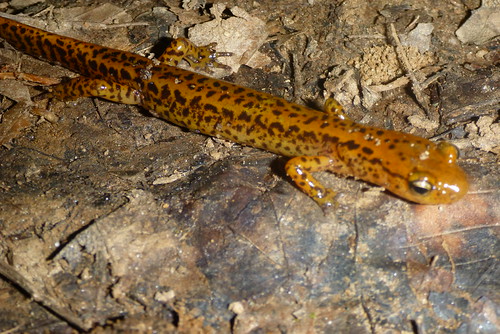
Perhaps one of the coolest of salamanders and the one species that has eluded me for many years was found by one of the surveyors in a seepage that fed into the main stream. This is the The Northern Red Salamander and apparently a recently transformed adult.

Herp hunting has become quite the addiction. Everyday since the temps became a steady 55 degrees and warmer I chomp at the bit to go outside and flip some logs, check the stream banks, or simply walk the trails and pathways near my home here in Northern Virginia. Most of the time I find the same old same old, two line and red back salamanders, worm and ring neck, and the ever reliable eastern black rat and water snakes, green and gray tree frogs, and box turtles, broadhead and five line skinks. sometimes I get spoiled and admittingly a little bored with finding the same species but still knowing that there are other species to be found keeps the “drive” going.
Recently I have taken additional steps to promote temporary habitats for herps-mostly snakes. A recent mole king snake discovery under a tire not far from my usual stomping grounds was encouraging and therefore I took it upon myself to distibute playwood coverboards within the vacinity of the discovery area hoping to entice another mole king and anything else that might seek shelter in the region. Ideally corregated tin and carhoods would provide better hides but I think I would probably run into opposition form the locals for “trashing” the neighborhood.
So far the boards havent produced anything nor has the original tire where the mole king was found. My old coverboards from three years ago regularly produces ringneks and worm snakes. Just need to be patient I guess.

 Our four hour drive began at 4:30 am Saturday May 12, 2012. Mike and I received our invitation to attend the Canebrake Survey several months earlier and were looking forward to our first wild rattlesnake observation. The Canebrake Rattlesnake is listed as VA State endangered and therefore protected. According to the Biologist leading the survey the population density of these animals is approximately 1 per 70 acres! So finding one even with twenty sets of herper eyes was quite a challenge.

(above) Canebrake in ambush position. Note the position and angle of its head resting perpendicular to the log waiting for unsuspecting rodent.
Our survey took place on land with restricted access and consited of a combination of open agricultural fields and pine tree scrub canebrakes and wetlands. During the survey there were several other species of snakes caught one of which was red bellied water snake.

There were also a few phibs and lizard such as squirrel tree frog, Pinewoods tree frog, a few toads marbled and Atlantic salamanders. Lizards found were broadhead, five lined and ground skinks. In the end a Canebrake was eyeballed by a former student of mine Ryan Collister and curent student of Organismal Biology at CNU. He was also the one who caputred the red bellied water snake. Funny thing I heard another herp team say to one another “lets get as far away as we can from these two-refering to Ryan and his herp partner Dane Conely.
The notion that these two young adults age 16 and 20 would create too much of a disturbance and therefore minimize the chnaces for the “experienced “herpers of finding a canebrake. Well as it turned out Ryan not only found the only canebrake but a nice red bellied water snake too.

Around 3:00pm the Canebrake Survey was over. A healthy number of herps were found including two Canebrakes that were recovered and released. Mike and I decided to make a run for VA beach to a place called Back Bay National Wildlife Snactuary. There we were to meet up with Ryan and Dane in the hopes of getting some late afternoon herping in. Back Bay has a nice diversity of herps the most coveted on this trip was to find water moccassins. That evening as we pulled into the parking lot we could see that Ryan and Dane had already arrived. Ryan could be seen holding up some sort of snake and appeared to be giving some tourist a lesson on the animal. Mike and I approached and could see that Ryan had caught a nice Brown Water Snake. Dane on the other hand was in the process of getting a juvenile Brown on his own which had been seeking refuge inbetween some rocks along the bay shoreline. The evening was sparse in terms of water moccasins. Ryan did manage to find a semi blind one laying coiled up in some salt marsh grass.

Just before dark Dane and Ryan, both veterans of Back Bay Herping, showed Mike and I some of their other productive sites. This time we saw but did not capture a northern water snake, watched a black racer take to the water to avoid capture but several other racers were captured under some debris areas later on. On our way back to the parking lot Dane caught a nice narrow mouth toad. These things were calling like crazy in the marsh areas between the bay and the ocean.
We said our good byes and Mike and I settled in a hotel room for the evening along VA Beach’s main drag. The next day Mike and I revisited Back Bay to try our luck at finding some larger Moccassins. The first hour wasnt producing much but we remained persistent traveling back and forth over the same area until finally I spot a baby lying coiled up in salt marsh grass. We take some pics and video then move on looking for the big ones that apparently inhabit the area. After about 15 minutes Mike gives out a shout – an adult crosses the path and makes it way into the marsh and remains long enough for Mike and I to get some video of the animals notorious defensive behavior.

