
Me standing in front of the Hermitage Restaurant aftermath of the remnants of a Tropical storm Hann came through the area summer of 2008
Me standing in front of the Hermitage Restaurant aftermath of the remnants of a Tropical storm Hann came through the area summer of 2008
 A very common bird found around here in the summer months. Very vocal! One of their calls, which I heard frequently sounded something like “teacher-teacher-teacher teacher” The bird pictured here was observed near a nest of hatchlings (and is presumably one of the parents) the interesting thing about the nest was that it was constructed in a hanging flower pot on the Booth’s porch. Nesting in hanging flower pots apparently is a common practice with this species
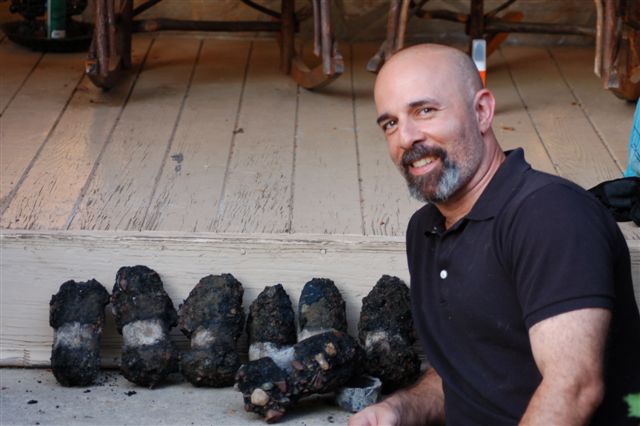 A friend of mine and I found these Hotchkiss artillery projectiles in a dried up stream bed. With a little research, some common sense and an adventurous mind, my friend and I discovered two fords along this stream last year. While walking along the stream laying on top of the dry ground were multiple artillery pieces like the ones shown here. Other finds included a couple of cannon balls, three belt buckles, a spur, a Yankee Cavalry uniform coat button, numerous gun barrels, some pieces to a sword and pocket loads of lead bullets. It isn’t often that such places can be found in plain site. We are currently trying to piece together the history behind this discovery. More details about the history of these fords to follow and perhaps more artifacts to recover as the water level continues to drop!!
 More common in warmer climates than in the north, this rare member of the orchid family might catch your eye, even when it’s not in bloom, because of its distinctive white veined leaves covered with fine white hairs. The bluish green basal leaves sprout from a perennial rhizome, and the top of the 8″ to 16″ stem is covered with many pubescent yellowish white flowers. (July to Sept.) It is found in dry woods.
It owes its common name, Rattlesnake Plantain, to three characteristics. The first is the tendency of the stem to achieve a snake like form as it pushes up through the dense carpet of leaves that covers the floor of the forest habitat it likes to grow in. The second characteristic is the rattlesnake pattern of the veining on the basal leaves, and the third is its value as a root tea to the American Indians to supposedly counteract the effects of snakebite. The root tea was also used for pleurisy. A leaf tea was administered with whiskey as a blood tonic, appetite stimulant, and cold remedy. Steeped in milk, leaf poultices were used to treat skin irritations. Possibly because of its medicinal value, and most certainly because people like to collect it for use in terrariums, it has become somewhat rare. If you’re lucky enough to discover rattlesnake plantains in the wild, please don’t disturb them. They might not survive out of their habitat because wild orchids aren’t easy to cultivate. The plant also goes by the names Adder’s Violet and Netleaf Plantain.
