Huntley Meadows. A Palustrine Forest and Marsh Community Along Northern Virginia’s Eastern Fairfax County Coastal Plain.
On this field trip took place we explore an area along the coastal plain of Northern Virginia. This area is known as Huntley Meadows, a wet lowland area remnant of geologic time when the Potomac River’s banks stretched further inland than where it is today. The wetland area that is known as Huntley meadows has gone through several transformations naturally as well as anthropogenic. Nonetheless Huntley has rebounded into a freshwater wetland with some of the rarest habitats left in Fairfax County.
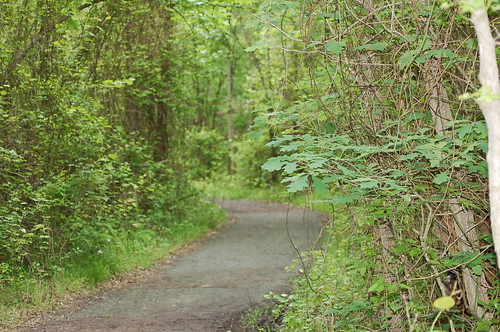
At Huntley, we explored two wetland communities, a palustriane forest and a nontidal freshwater Marsh. Palustrine forests are defined as all nontidal wetlands dominated by trees, shrubs, persistent emergent plants, or emergent mosses or lichens, as well as small, shallow open water ponds. Ponds were not obvious within the forest. There was, however, evidence of drainage and damp depresions where water had collected during the springtime rains. It is my understanding much of the water that flows through Huntley’s palustrine forest comes from episodic rainfall.
The most obvious features of the palustrine forest in comparison the to the marsh is the variety of broadleaf, deciduous hardwoods. These included red maple, several types of oaks and hickories, and birch trees. Several of these species exhibit multi-trunking a feature typical of trees that live in hydric soils. A few species such as red maple and sycamore thrived within the ecotone of the two comunities. Absent from the forest were dense shrubs or an understory layer. The lack of smaller trees or saplings and other lowlying shrubs may have been due to overgrazing by local deer populations. On ther otherhand what was most numerous in density was Japense stiltweed, an extremely opportunistic and invasive herbaceous plant that carpeted the forest floor.
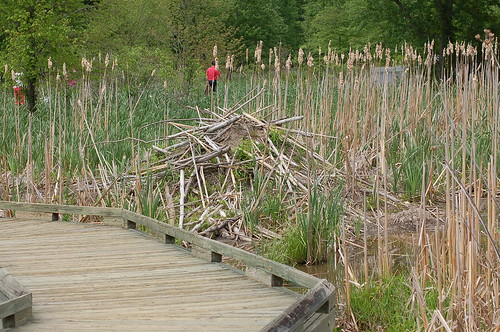
The transition between Forest and marsh is abrubt and the two communities are different physically and biologically. The most obvious difference is there are very few trees or woody plants in the marsh and there is a more permanent body of stadning water. A Marsh is a wetland dominated by herbaceous or nonwoody plants that often develop in shallow ponds or depressions. The first clue we were entering the marsh was the lack of woody plants and tree canopy. Instead there was an open area rich in herbaceous flora, muddy sediments and shallow water. Diversity in flora was greater in this community than the forested region.
My Mom standing next to root ball of fallen tree
The area that is home to the two communities we focused on has been altered over the centuries by human occupation, but has always managed to rebound. Huntley Meadows is not just a static repository of the flora of flora and fauna, but an ecosystem rich in diversity that will continue to evolve though the ages.
Zone: Palustrine Forest Flora
| Scientific Name |
Common Name |
Plant Type |
Remarks |
| Toxicodendron radicans |
Poison Ivy |
Vine |
Abundant |
| Liquidambar styraciflua |
Sweet Gum |
Tree |
|
| Microstegium vimineum |
Japanese Stilt Grass |
Grass |
Abundant/invasive |
| Quercus phellos |
Willow Oak |
Tree |
Infrequent |
| Boehmeria cylindrical |
False Nettle |
Herb |
Simple toothed leaves, flowers off stem node |
| Betula nigra |
River Birch |
Tree |
Multi trunk papery bark |
| Acer Rubrum |
Red Maple |
Tree |
Multi Trunking |
Zone: Palustrine Forest and Marsh Ecotone
| Scientific Name |
Common Name |
Plant Type |
Remarks |
| Onoclea sensibilis |
Sensitive Fern |
Herb |
Obligate. Moisture sensitive |
| Platanus occidentalis |
Sycamore |
Woody/Tree |
|
| Acer Rubrum |
Red Maple |
Woody/Tree |
Multi Trunking |
| Veronia novemboracensis |
NY Ironweed |
shrub |
Aster family purple flowers |
| |
|
|
|
Zone: Marsh
| Scientific Name |
Common Name |
Plant Type |
Remarks |
| Cuscuta gronovii |
*Dodder |
Vine |
Parasitic * |
| Vibernum dentatum |
Arrow-wood Vibernum |
Shrub |
See elderberry. Relative and similar charact. |
| Cyperus strigosus |
Flatsedge? |
Sedge |
Abundant |
| Impatiens capensis |
Jewel Weed |
Herbaceous |
Fleshy stem, orange yellow flowers. Remeedy to Poison Ivy |
| Sambucus cnanadensis |
Elderberry |
shrub |
Umble fruits. Red color compound leaves |
| Salix nigra |
Black Willow |
Tree |
|
| Juncus effusus |
Common rush? |
Emergent |
|
| Scirpus cyperinus |
Woolgrass Sedge? |
Sedge |
|
| Eleocharis |
Spikerush |
Emergent |
“conelike” flowers at tip. Dense can form hammocks in etland |
| Leersia oryzoides |
Cutgrass |
Grass |
Recurved epidermal cells-Cuts! |
| Asclepias incarnata |
Swamp Milkweek |
Emergent |
|
| Rosa palustris |
Swamp Rose |
Shrub |
Got one in my eye last March! |
| Typha latifolia |
Broad leaf Cat-tail |
Emergent |
Male and female flower on same sructure |
| Cephalanthus occidentalis |
Buttonbush |
Shrub |
Flowers round colonial buttons, butterfly pollinated |
| |
|
|
|
| Hibiscus moscheutos |
Swamp Mallow/Marsh Mallow |
Shrub |
Large showy white flowers. Pin type flower |
| Polygonum arifolium |
Halbard-leaved tearthumb |
Herbaceous |
Recurved spines on stem |
| Polygonum sagittatum |
Arrow-leaved Tearthumb |
Herbaceous |
|
| Saururus cemuus |
Lizard Tail |
Emergent |
Elongated flowers, obligate wetland |
| Hydrocotyle ranunculoides |
Pennywort |
Emergent |
Aquatic very dense |
| Llex verticillata |
Deciduous Holly |
Herbaceous |
Winterberry |
Zone: Palustrine Forest and Marsh (observed in both communities)
| Scientific Name |
Common Name |
Plant Type |
Remarks |
| Acer Rubrum |
Red Maple |
Woody/Tree |
Multi Trunking |
| Platanus occidentalis |
Sycamore |
Woody/Tree |
Large leaves |
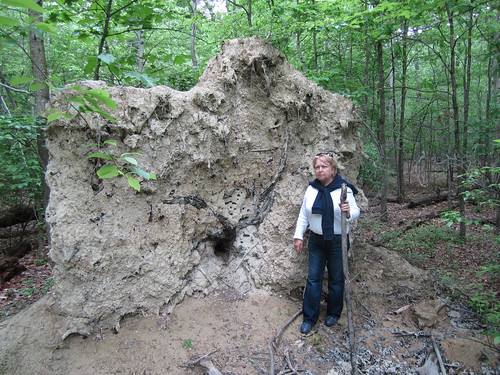
Mom standing next to root ball of fallen tree
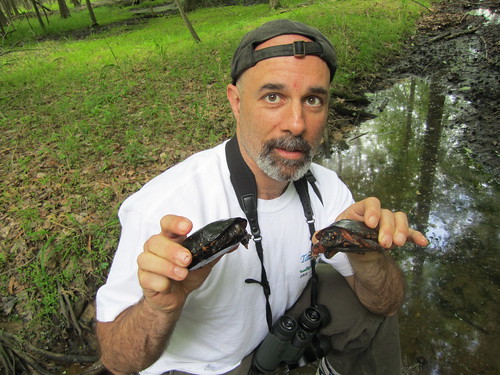
Me holding a pair of spotted turtles I caught in a drain leading from forest into open wet area.